India’s property market is one of the most structurally diverse in the world. Depending on which city you are buying in, which authority developed the land, and what the original land use classification was, you could be purchasing a property under dramatically different ownership frameworks — with equally dramatic differences in your legal rights, resale options, home loan eligibility, and long-term financial outcome. The three foundational concepts that every property buyer in India must understand before signing anything are land classification, freehold ownership, and leasehold ownership.
Getting these definitions right before the documentation phase is not a technicality — it is a financial safeguard.
Land Classification in India
Indian land is categorised under multiple frameworks simultaneously — by revenue classification, by land use designation, and by development authority jurisdiction. At the revenue level, land is broadly classified as agricultural land, non-agricultural or NA land, government land, forest land, tribal land, and waste land. For residential property purchases, the most critical distinction is between agricultural and non-agricultural land. Purchasing agricultural land in most Indian states for residential construction without proper conversion to non-agricultural use is illegal and can result in the property being seized or demolition of structures built on it.
State governments designate land use through their development plans — residential, commercial, industrial, mixed-use, and open space zones. Construction permissions are issued only where the land use designation permits the proposed development. A property built in a commercial zone without a change-of-use approval, or in a no-development zone, carries permanent legal risk regardless of how long it has stood or how many parties have transacted it previously.
In urban areas, land is further classified by which authority controls it — development authorities like DDA in Delhi, MHADA in Maharashtra, BDA in Bengaluru, or private developers with absolute land ownership. This authority classification directly determines whether your property will be freehold or leasehold.
Freehold Property: Complete and Perpetual Ownership
A freehold property gives the buyer complete and permanent ownership of both the structure and the land on which it stands. Once the sale deed is executed and registered in your name, you are the absolute owner with no time limit, no authority to whom you must pay ground rent, no permission required for sale or transfer, and no risk of ownership reverting to anyone else. The property can be sold, mortgaged, gifted, renovated, or inherited by legal heirs — all without requiring a No Objection Certificate from any governing body.
Most independent houses sold by private developers and individual sellers in India’s major cities are freehold. Private plotted developments, bungalows in residential layouts, and most new-age residential townships on privately owned land are freehold. This makes freehold property the preferred choice for long-term investment, as it combines maximum ownership security, higher resale demand, and stronger collateral value for home loans.
The only rider is that even freehold land can technically be acquired by the government for public purposes under the Land Acquisition Act — a power that exists in theory but in practice applies primarily to land in the path of infrastructure development.
Leasehold Property: Conditional Ownership With a Tenure
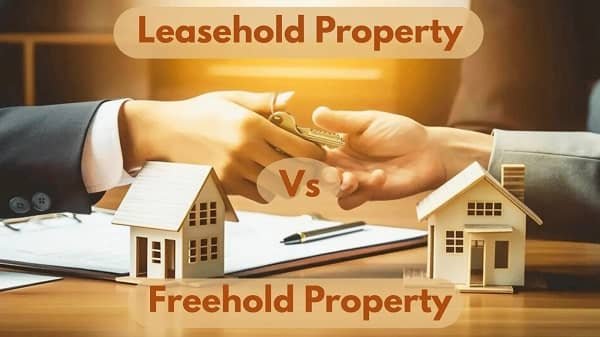
A leasehold property means you own the structure built on the land but not the land itself. The land is owned by a government authority or developer — the lessor — and leased to you for a defined period, typically 30, 60, 90, or 99 years, sometimes extending to 999 years in older colonial-era documentation. During the lease term, you have the right to occupy, use, and in most cases sell or rent the property, but you must pay periodic ground rent to the land authority and may need a No Objection Certificate from that authority for sale or mortgage.
In India, large swathes of urban real estate are leasehold. Delhi Development Authority (DDA) flats, MHADA schemes in Mumbai, CIDCO developments in Navi Mumbai, and many government quarters across major cities are classic examples. A significant portion of Delhi’s residential housing stock — particularly in colonies developed by DDA — is technically leasehold, with land owned by DDA and leased to buyers.
The most critical concern with leasehold property is what happens as the lease approaches expiry. Renewal is usually possible but not always automatic — it may require payment of additional charges to the authority, fresh documentation, and administrative timelines that can delay sale transactions. Banks are also more cautious about home loans on leasehold properties with shorter residual lease terms, as the collateral value diminishes as the lease period shrinks.
Apartment Flats: The Structural Reality
Most apartment flats in India fall into a grey zone between these two frameworks. The developer typically acquires the land on either a freehold or leasehold basis. In a cooperative housing society structure, flat owners collectively own the land through the society after conveyance. Under RERA-mandated structures, the developer must transfer the common area and land to the legal entity formed by flat owners — a Residents’ Welfare Association or cooperative housing society — after project completion. Until this transfer happens, individual flat owners technically own only their unit, not a share of the land.
Verifying whether the land has been conveyed to the society is one of the most important but frequently overlooked checks in apartment purchase due diligence.
FAQs
Q: Can I buy agricultural land for residential construction in India?
A: Not without formal conversion to non-agricultural use approved by the relevant state authority. Building on unconverted agricultural land is illegal and carries demolition and legal risk.
Q: What happens to a leasehold property when the lease expires?
A: The property reverts to the original land owner — typically a government authority — unless the lease is renewed. Renewal usually involves additional charges and documentation, and is not always guaranteed.
Q: Are DDA flats freehold or leasehold?
A: Most DDA flats are leasehold — the land is owned by DDA and leased to the allottee for 99 years. However, DDA has historically allowed conversion to freehold on payment of a defined conversion fee.
Q: Is it harder to get a home loan on leasehold property?
A: Yes — banks require a minimum residual lease term (typically 30 years beyond the loan tenure) and may impose stricter conditions. Leasehold properties with short remaining terms may not qualify for standard home loans at all.
Q: Which is better for investment — freehold or leasehold?
A: Freehold is consistently preferred for long-term investment due to perpetual ownership, no ground rent liability, better resale demand, and stronger home loan eligibility. Leasehold is considered only when lower entry cost or specific location access makes it worthwhile.