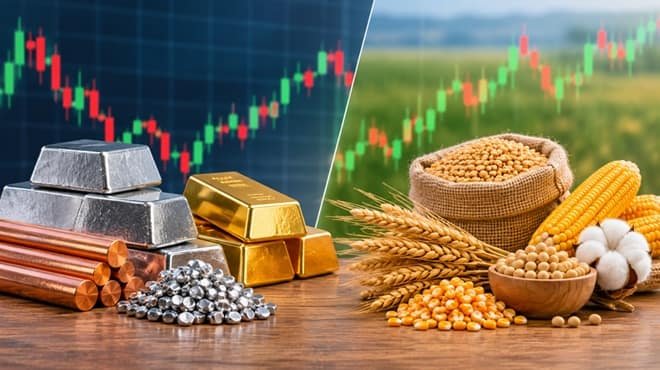
Commodity markets give participants access to a range of raw materials, from gold and silver to wheat, cotton and soybean. However, these commodities do not respond to the same market forces. Metals are strongly influenced by global economic activity, industrial demand, and currency movements, while agricultural products are more closely linked to weather, crop cycles, and government policies.
Understanding these differences is important for anyone studying commodity trading in India. The factors that affect supply, demand, pricing, storage and volatility can vary significantly between metal and agricultural markets.
Understanding Commodity Trading in India
Commodity trading involves buying and selling contracts based on the expected price of an underlying commodity. In India, commodity derivatives are traded on recognised exchanges, with contracts specifying details such as quantity, quality, expiry and delivery conditions. To participate, you first need to Open Demat Account and a linked trading account with a registered broker.
The market covers several categories. The main Types of Commodities include metals, agricultural products, energy commodities and other raw materials. Each category has its own supply chain and price drivers.
Metals and agricultural products are particularly different because their production cycles, storage requirements and responses to external events vary considerably.
How Metals Behave in Commodity Markets
Metals include commodities such as gold, silver, copper and aluminium. Their prices can be influenced by domestic and international developments.
Precious metals such as gold and silver can respond to interest rates, currency movements, inflation expectations, investment demand and global economic uncertainty. Industrial metals such as copper and aluminium are more closely connected with manufacturing, construction, infrastructure and broader industrial activity.
Storage is another important consideration. Metals can generally be stored for longer periods with limited deterioration when appropriate conditions are maintained. As a result, inventory levels and warehouse stocks can influence market expectations.
Global developments also have a significant role. Changes in mining output, refining capacity, international demand and import costs can affect prices in the Indian market.
How Agricultural Products Differ
Agricultural commodities include products such as wheat, soybean, cotton and sugar. Their prices depend heavily on production conditions and crop availability.
Weather is one of the most important influences. Excessive rainfall, drought, temperature changes and other weather events can affect crop yields and alter supply expectations. Pest attacks and changes in cultivated acreage can have similar effects.
Agricultural commodities also have clear production cycles. Sowing and harvesting periods can influence supply expectations throughout the year. Government decisions on imports, exports, procurement, and other agricultural policies can also affect domestic prices.
Storage presents another distinction. Certain agricultural products require controlled storage conditions, while some can deteriorate in quality over time. This makes inventory management particularly relevant to their pricing.
Metals vs Agri Products: Key Differences
The differences become easier to understand when the major market factors are compared side by side.
| Factor | Metals | Agricultural Products |
| Main supply drivers | Mining, refining and industrial production | Crop production, acreage and harvests |
| Major price influences | Industrial demand, interest rates, currencies and global economic conditions | Weather, crop estimates, inventories and government policies |
| Seasonality | Generally less dependent on seasonal production cycles | Strongly influenced by sowing and harvesting cycles |
| Storage | Generally easier to store for longer periods | May require specific conditions and careful handling |
| Global influence | Strong connection with international metal markets | Influenced by global crop production and trade |
| Key risks | Economic slowdowns, currency movements and supply disruptions | Weather events, crop failures, policy changes and supply fluctuations |
This comparison shows why a market participant cannot apply the same analysis to every commodity. The underlying characteristics of each product determine which factors deserve greater attention.
Why Seasonality Matters More for Agri Commodities
Seasonality is one of the clearest differences between the two categories. Metal production is influenced mainly by mining activity, industrial output and processing capacity, rather than fixed agricultural seasons.
Agricultural commodities, on the other hand, move through distinct production stages. Market participants may monitor:
- Sowing progress and cultivated acreage
- Weather conditions during crop development
- Production and yield estimates
- Harvest expectations
- Domestic and international inventory levels
- Import and export policies
These factors can change expectations about future supply well before the physical crop reaches the market. Therefore, agricultural price movements may sometimes begin before actual changes in available stocks become visible.
Monitoring these factors can provide context for understanding why an agricultural commodity may behave differently from a metal during the same period.
The Role of Global Markets
Indian commodity prices can also be affected by international developments. This is particularly relevant for commodities that are widely traded across global markets.
For metals, international mining output, industrial demand, major economic developments and currency movements can have a substantial effect. Changes in production or consumption in major economies can influence global prices and, in turn, domestic markets.
Agricultural commodities are also affected by international conditions. Crop production in major exporting countries, global inventories, trade restrictions, and overseas weather conditions can influence domestic price expectations.
Currency movements are relevant to both categories because changes in the value of the Indian rupee can affect the domestic price of internationally traded commodities.
Risks to Consider Before Trading
Although the risks vary between commodities, both categories can experience significant price fluctuations. Understanding the specific risks is therefore important before entering a derivative contract.
Metal prices can react quickly to changes in global economic conditions, monetary policy, industrial demand and geopolitical developments. Precious and industrial metals may also respond differently to the same event.
Agricultural commodities can experience sudden price changes following weather disruptions, revised production estimates, changes in inventories or government policy decisions.
Participants should also understand the risks associated with leverage. Derivatives can magnify both gains and losses, making it important to consider margin requirements, contract specifications and expiry dates before taking a position.
Choosing Between Metals and Agri Products
There is no single approach that applies to every commodity. The choice depends on factors such as market knowledge, objectives, risk tolerance and the ability to follow relevant market developments.
Someone studying metals may need to focus more on global economic indicators, industrial demand, currency movements and mining activity. An agricultural market requires closer attention to crop cycles, weather conditions, production estimates and agricultural policies.
Learning about different types of commodities can help market participants understand why these markets behave differently. Instead of analysing every commodity with the same indicators, it is more useful to identify the specific supply and demand factors affecting each underlying product.
Conclusion
Metals and agricultural products both play important roles in Indian commodity markets, but their price movements are driven by different factors. Metals are closely linked to global economic activity, industrial demand and financial factors, whereas agricultural products are more sensitive to weather, production cycles, inventories and policy decisions.
Understanding these distinctions can help participants interpret market movements more carefully. Before engaging in commodity trading, it is important to study the underlying commodity, understand its contract specifications and assess the risks involved. Keeping track of both domestic and international developments can also provide useful context when evaluating commodity markets.