57,443 MW. That’s India’s total installed wind capacity as of June 30, 2026, according to Ministry of New and Renewable Energy data placed before the Lok Sabha. That puts India fourth globally in wind capacity, behind only China, the United States, and Germany. Most of that capacity runs on one generator architecture. Good luck finding a classroom that actually lets students touch it.
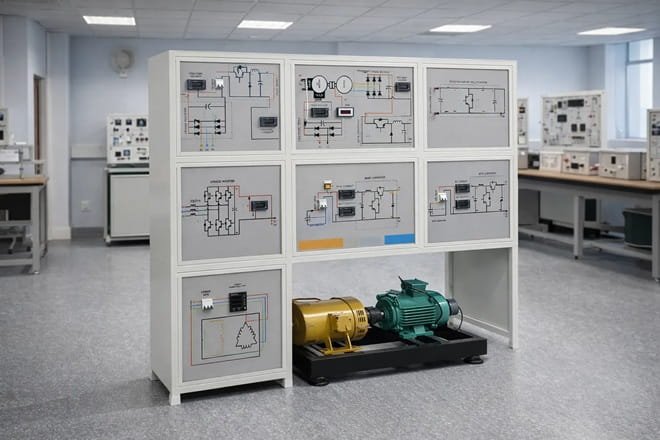
That’s the gap a dfig wind turbine emulator is built to close. Real wind farms aren’t something you can wheel into a lab. A well-built emulator gets close enough that the physics, the control loops, and the failure modes all behave the way they would on an actual turbine, minus the weather and the 80-meter tower.
Why DFIG Still Dominates Utility-Scale Wind
Doubly-fed induction generators have been the backbone of variable-speed wind conversion for decades now, and it’s not because nothing better exists. It’s because the trade-off works. A DFIG pairs an induction rotor with a partially rated bidirectional converter connected through slip rings, which means the grid-side converter only has to handle a fraction of total power output instead of the whole thing.
That partial rating is the whole point. Full-scale converters cost more and lose more energy to conversion. DFIGs sidestep both problems while still allowing variable-speed operation, which lets the turbine chase the wind’s actual speed instead of running at one fixed RPM regardless of conditions.
The market reflects that staying power. Estimates vary depending on which research firm you ask, but figures in the $3.5 to $8 billion range for 2024, growing at a compound annual rate somewhere between 5 and 8.5 percent through the early 2030s, show up across several independent market reports. India alone added a record 6.05 GW of wind capacity in FY26, a 46 percent jump over the previous year, and the country is targeting 100 GW of wind capacity by 2030. Not explosive growth globally. Steady, mature-technology growth instead, with India’s pipeline accelerating faster than most.
What a Lab-Grade Emulator Actually Needs to Replicate
Building a dfig wind turbine emulator isn’t just spinning a motor and calling it a turbine. The rotor-side converter needs to replicate real slip control, letting students see how rotor frequency shifts as wind speed changes relative to synchronous speed. Miss that, and you’re teaching a simplified fiction instead of the actual machine.
Grid fault behavior matters too, arguably more than steady-state operation. Real DFIGs have to ride through voltage dips without disconnecting, a requirement baked into most modern grid codes. A student who never sees a low-voltage ride-through event on a lab bench has a gap in their understanding that a textbook diagram won’t fill.
Reactive power control is the third piece, and it’s easy to undervalue until you’ve watched a system struggle without it. Controlled reactive power injection is part of what lets DFIG-based wind farms support grid voltage stability rather than just dumping active power onto the grid and hoping for the best. A properly instrumented dfig wind turbine setup lets students watch that reactive power response happen in real time, rather than trusting a textbook’s word for it.
Where This Fits Into a Curriculum
For engineering programs building out renewable energy tracks, a working dfig wind turbine emulator gives students something a simulation alone can’t: real electrical behavior, real timing delays, real noise in the control loop. Simulink models are useful for intuition. They don’t teach you what happens when a sensor reading is slightly off, or when a converter’s switching frequency interacts with something unexpected in the mechanical drivetrain.
That gap between simulated and physical behavior is exactly where engineers learn the most, frankly. It’s also where the mistakes are cheapest to make, which is the entire argument for a lab bench over a live wind farm.
The Bigger Picture
Wind energy isn’t going anywhere, and DFIG architecture isn’t likely to disappear from utility-scale installations anytime soon either. Direct-drive and permanent magnet alternatives have gained ground in offshore applications, sure, but the cost and complexity trade-offs still favor DFIG for a huge share of onshore capacity. Slip rings need more maintenance than a direct-drive system, that’s a fair criticism. But the lower converter cost and smaller footprint keep DFIG competitive almost everywhere maintenance access isn’t a constant headache.
Training the next generation of engineers on hardware that actually resembles what’s spinning on wind farms today isn’t optional anymore. It’s the difference between graduates who understand turbine control in theory and ones who’ve actually watched a rotor respond to a simulated gust in real time.