The notebook making business is one of India’s most consistently in-demand stationery manufacturing businesses — producing essential educational and professional writing products for a country with the world’s largest school-going population, a massive college student base, and significant corporate and government stationery requirements. India’s stationery market is valued at over ₹15,000 crore, with notebooks and writing pads representing a substantial and growing share driven by education sector expansion, rising school enrolment under government programs, and corporate stationery demand.
From a small manual notebook binding operation to a fully automated commercial notebook manufacturing plant, the business offers genuine opportunity at multiple investment scales. Understanding both sides of this manufacturing business helps entrepreneurs plan investments and operational strategies realistically before committing capital.
Advantages of Notebook Making Business
1. Consistently Essential Demand
Notebooks are non-discretionary educational essentials — every student requires fresh notebooks at every new academic year, creating annual demand renewal that most consumer products cannot claim. India’s approximately 260 million school students, 35 million college students, and enormous professional workforce collectively generate notebook demand that is structurally enormous and consistently growing with rising educational enrolment. Government school programs including free stationery distribution under various state schemes create additional institutional procurement demand that supplements retail market volumes.
2. Government Procurement Opportunity
State governments and central education departments procure notebooks in massive volumes for distribution to government school students under welfare programs — creating bulk institutional contracts that provide volume certainty and advance payment terms far superior to retail market dynamics. Becoming a registered supplier on the GeM (Government e-Marketplace) portal and meeting state education department quality specifications provides access to procurement contracts that can sustain an entire small manufacturing operation’s output independently of retail market competition. MSME registered notebook manufacturers receive procurement preference in government tenders.
3. Relatively Simple Manufacturing Process
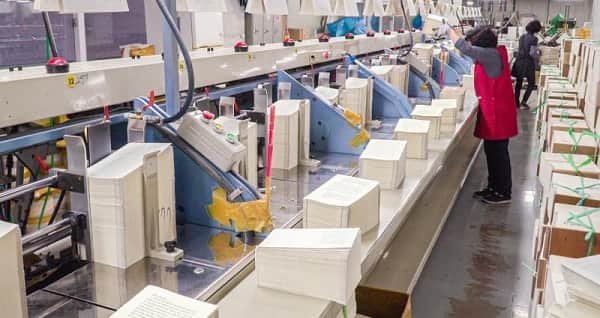
Notebook manufacturing — paper cutting, ruling, binding, and cover assembly — involves straightforward production processes that do not require advanced technical expertise or complex chemical formulations. Modern semi-automatic and automatic notebook making machines handle the primary production steps efficiently with trained but not highly specialised operators. This operational accessibility makes notebook manufacturing one of the more approachable small-scale manufacturing businesses for entrepreneurs without technical backgrounds who invest in appropriate equipment and operator training.
4. Low Raw Material Dependency
The primary raw material — paper — is a commodity produced by India’s substantial paper industry and distributed through well-established dealer networks across all manufacturing regions. Multiple paper suppliers competing for business maintain price competition and supply reliability that reduces procurement risk. Customisation through cover printing, ruling variation, and size specification allows notebook manufacturers to differentiate product ranges without additional raw material complexity beyond paper, cover board, and binding wire — materials whose supply chains are mature and geographically distributed.
5. Scalable with Automation Investment
Notebook manufacturing scales efficiently through progressive automation investment — manual operations serve small-scale institutional supply, semi-automatic machines handle medium commercial volumes, and fully automated lines serve large retail and institutional supply at costs per unit that justify investment through improved margin efficiency. Each automation stage improves per-unit economics while maintaining product quality consistency that manual production struggles to achieve at scale. This progressive scalability allows entrepreneurs to grow their manufacturing investment in line with demonstrated revenue rather than requiring upfront maximum capacity investment.
Disadvantages of Notebook Making Business
1. Intense Competition and Thin Margins
The notebook manufacturing market is intensely competitive — from large organised players like Classmate (ITC), Navneet Publications, and Kokuyo Camlin to thousands of small regional manufacturers competing on price in institutional and retail markets simultaneously. Standard notebooks are commodity products where price is the primary purchase determinant for bulk buyers — creating margin compression that leaves limited room for premium positioning without genuine quality or design differentiation investment. New entrants without established distributor relationships or institutional procurement access struggle to achieve the volume needed for viable margins.
2. Seasonal Demand Concentration
Notebook demand is heavily concentrated around the academic calendar — June–July school reopening creates the primary demand surge that represents a disproportionate share of annual revenue. Managing inventory, production scheduling, and working capital for peak season while sustaining operations through quieter months requires financial discipline that seasonal concentration demands. Manufacturers who over-produce for anticipated peak demand that doesn’t fully materialise carry unsold inventory whose value is time-sensitive as the next season’s requirement may favour different specifications.
3. Paper Price Volatility
Paper costs represent 55–65% of notebook manufacturing cost — making the business directly exposed to paper market price fluctuations driven by pulp costs, energy prices, and import duty changes. When paper prices increase, notebook manufacturing margins compress unless retail pricing can be adjusted — difficult in competitive markets where buyers are accustomed to stable prices and switch suppliers readily. Strategic paper inventory building during price dips requires working capital that creates its own financing cost against the expected procurement savings.
4. Capital Investment in Machinery
Commercially viable notebook manufacturing requires ₹5–20 lakhs in machinery investment — paper cutting machines, ruling machines, binding machines, and cover printing or lamination equipment. This capital creates EMI obligations that require consistent production volume to service. Equipment maintenance, periodic die and blade replacement, and occasional major repairs create ongoing capital requirements. Establishing adequate production capacity for institutional tender quantities — where volume requirements specify minimum daily output levels — requires machine investments that small entrepreneurs may find challenging to finance.
5. Distribution Building Requirement
Reaching retail customers through stationery shops, general stores, and modern retail requires building distribution relationships with local, regional, and national distributors who already carry established brands with proven sell-through. Convincing distributors to stock a new notebook brand against established alternatives requires either price advantages, quality differentiation, or institutional procurement credentials that new manufacturers take time to develop. Without adequate distribution reach, even quality notebook products remain commercially invisible to the majority of potential buyers.
Frequently Asked Questions (FAQs)
Q: Is notebook making business profitable in India?
A: Yes — a notebook manufacturing business with government supply contracts and established retail distribution achieves net margins of 12–20%. Specialised notebooks for premium segments achieve better margins.
Q: How much investment is needed to start notebook making business in India?
A: A small manual or semi-automatic unit requires ₹5–10 lakhs. A commercial-scale automated operation requires ₹15–30 lakhs including machinery, raw materials, and working capital.
Q: What licences are required for notebook making business in India?
A: Factory licence, MSME Udyam registration, GST registration, BIS certification for specific paper products, and trade licence are primary requirements.
Q: How do I get government notebook supply contracts in India?
A: GeM portal registration, state education department vendor empanelment, and meeting specified quality standards are the primary pathways for accessing government notebook procurement contracts.
Q: Which notebook sizes have the highest demand in India?
A: A4 and A5 size notebooks are most widely demanded across student and professional markets. Long notebooks and short notebooks serve specific regional preferences in different state markets.