The mushroom business has emerged as one of India’s most exciting, most rapidly growing, and most genuinely accessible agricultural entrepreneurship opportunities — combining low land requirements, short production cycles, high nutritional value market positioning, and strong demand growth into a business model that rewards both small-scale home growers and commercial-scale producers. India’s mushroom market is growing at 15–20% annually, driven by rising health consciousness, growing vegetarian protein demand, expanding restaurant and hospitality sector consumption, and increasing export demand for Indian mushroom varieties.
From a spare-room oyster mushroom growing operation to a commercial button mushroom farm supplying supermarkets and restaurants, the mushroom business offers genuine opportunity at every capital level. Understanding both sides honestly helps aspiring mushroom entrepreneurs plan realistically.
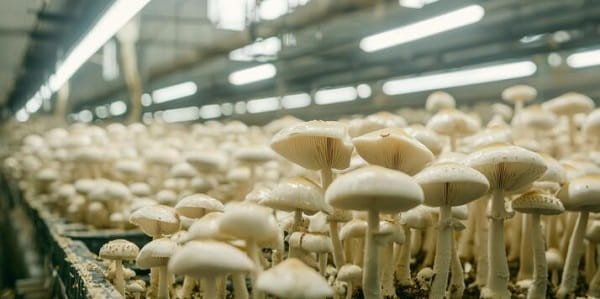
Advantages of Mushroom Business
1. Very Low Land and Space Requirement
Mushroom cultivation’s most distinctive agricultural advantage is its extraordinarily efficient space utilisation — mushrooms grow vertically on stacked substrate bags or shelving systems, producing significant yields from spaces as small as a single room. A 500 square foot growing room can produce 200–500 kg of oyster mushrooms monthly — productivity per square foot that no conventional crop farming can approach. This space efficiency makes mushroom cultivation viable in urban and peri-urban settings where land availability and cost would make conventional farming impossible, dramatically expanding the potential farmer base beyond traditional agricultural communities.
2. Short Production Cycle and Fast Revenue
Oyster mushrooms — India’s most popular and most accessible commercial variety — produce first harvest within 25–30 days of substrate preparation. This extraordinarily short production cycle creates monthly harvest and revenue cycles that allow rapid business testing, quick adaptation to market conditions, and fast cash flow generation that most agricultural businesses with seasonal 6–12 month crop cycles cannot achieve. The ability to generate revenue within the first month of operation dramatically reduces the financial runway required for new mushroom businesses compared to conventional crop farming.
3. Strong and Growing Health Market Demand
Mushrooms are experiencing extraordinary demand growth driven by their nutritional profile — high protein content, immune-boosting beta-glucans, vitamin D, and antioxidant properties that align perfectly with India’s growing health and wellness consumer movement. Health-conscious urban consumers actively seek mushrooms as meat alternatives, functional food ingredients, and everyday nutrition additions. Premium varieties including shiitake, lion’s mane, and reishi — grown for both culinary and health supplement markets — command significantly higher prices than button mushrooms and represent rapidly growing premium market segments with strong margin potential.
4. Low Initial Investment
A basic oyster mushroom growing operation can be established with ₹20,000–₹50,000 — covering substrate materials, spawn, growing bags, basic shelving, and humidity management equipment. This minimal investment makes mushroom farming one of the most financially accessible agricultural businesses available. Government agricultural departments and NABARD provide additional financial support through mushroom cultivation training programs and project financing schemes that further reduce effective startup capital requirements. The low entry cost allows entrepreneurs to scale incrementally — reinvesting harvest revenue into production expansion rather than requiring large upfront capital commitments.
5. Multiple Revenue Channels and Product Forms
Mushroom businesses generate revenue across multiple simultaneous channels — fresh mushroom sales to households, restaurants, and vegetable vendors; dried mushroom powder for health supplement and food processing markets; mushroom pickle and value-added product development; spent substrate composting for agricultural sales; and mushroom spawn production for supply to other growers. This product and channel diversity provides both revenue stability and margin improvement opportunities that single-product, single-channel agricultural operations cannot achieve. Building value-added product capability alongside fresh sales progressively improves the business’s overall economics.
Disadvantages of Mushroom Business
1. Highly Perishable Product
Fresh mushrooms deteriorate rapidly — shelf life of 3–5 days at ambient temperature and 7–10 days under refrigeration creates daily harvest management pressure requiring immediate sale or processing to prevent complete loss. This perishability demands reliable daily market connections — restaurants, vegetable vendors, and direct consumers who purchase consistently each harvest cycle. Building these market relationships before scaling production is essential, because unsold daily harvests represent complete financial loss of the cultivation investment for that cycle. Cold chain requirements for extended shelf life add infrastructure cost.
2. Temperature and Humidity Control Requirements
Mushroom cultivation requires precise environmental management — temperature, humidity, CO2 levels, and light conditions must all be maintained within specific ranges for each cultivation stage. Oyster mushrooms require 25–30°C during spawn run and 18–22°C during fruiting — parameters that India’s climate makes challenging to maintain naturally during summer months without air conditioning investment. Any environmental management failure — a humidity collapse, temperature spike, or contamination event — can wipe out an entire cultivation batch, creating direct financial loss with no revenue recovery. This environmental dependency creates operational risk that conventional outdoor farming does not face equivalently.
3. Contamination Risk and Technical Knowledge Requirement
Mushroom cultivation is technically more demanding than most casual observers appreciate — substrate sterilisation, spawn inoculation sterility, and growing environment hygiene all require genuine technical knowledge and disciplined practice to maintain contamination-free production. Competing moulds, bacteria, and pest fungi that contaminate inadequately sterilised substrate or poorly maintained growing environments cause crop loss with limited recovery options. Building the contamination management competency needed for consistent commercial production requires proper training investment and practical experience that cannot be shortcut without production quality consequences.
4. Market Development and Awareness Building
Despite growing demand, mushroom market awareness outside urban centres and restaurant supply chains remains limited — many potential retail customers in smaller cities and towns are unfamiliar with mushroom cooking and need education before becoming regular buyers. Developing reliable daily purchase commitments from sufficient buyers to absorb consistent production requires sustained market relationship building that takes time and personal sales effort to establish. Initial producers frequently discover that their production capability exceeds their established market relationships — creating unsold harvest loss during the market development phase.
5. Quality Consistency and Buyer Standards
Commercial buyers — supermarkets, hotels, and restaurant chains — require consistent quality grading, packaging standards, and reliable delivery schedules that small mushroom producers struggle to maintain consistently. Mushroom size, colour uniformity, and freshness standards that commercial buyers specify are more demanding than informal market standards. Building the quality management systems, grading capability, and delivery reliability needed to serve commercial buyers requires operational investment beyond basic production that many small growers initially underestimate when targeting premium commercial clients.
Frequently Asked Questions (FAQs)
Q: Is mushroom business profitable in India?
A: Yes — a commercial mushroom farm with established market relationships achieves net returns of 25–40% on investment. Value-added processing businesses achieve stronger margins than fresh mushroom trading alone.
Q: How much investment is needed to start mushroom business in India?
A: A basic oyster mushroom operation starts at ₹20,000–₹50,000. A commercial-scale production unit requires ₹2–8 lakhs including climate control, shelving, and substrate processing equipment.
Q: Which mushroom variety is most profitable to grow in India?
A: Oyster mushrooms offer the best combination of ease of cultivation, production speed, and market demand for new growers. Shiitake and reishi mushrooms command higher prices in premium health markets.
Q: What licences are required for mushroom business in India?
A: FSSAI food business registration for commercial sales, GST registration once thresholds are crossed, and basic agricultural produce trading licence where applicable are primary requirements.
Q: Can mushrooms be grown at home commercially in India?
A: Yes — home-based oyster mushroom growing is entirely viable commercially in a spare room or garage with proper climate management, and many successful commercial growers began in home setups before establishing dedicated facilities.