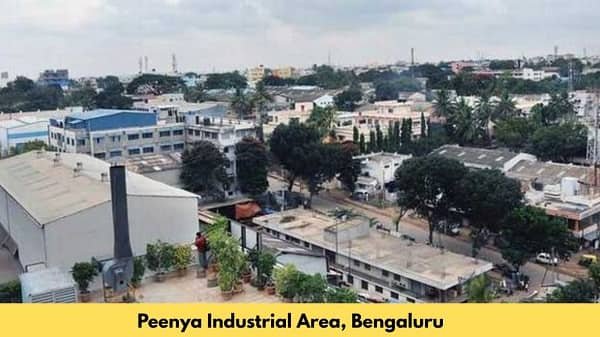
Peenya Industrial Area is one of the largest and most influential industrial zones in India and Southeast Asia. Located in the northwestern part of Bengaluru, this massive industrial estate has played a crucial role in shaping the city’s manufacturing economy for decades. Established during the 1970s, the area has grown into a vast industrial ecosystem that supports thousands of factories, engineering units, and technology-driven manufacturing companies.
Spread across nearly 40 square kilometers, Peenya Industrial Area is often described with the phrase “pin-to-plane,” reflecting its ability to manufacture everything from small mechanical components to complex aerospace parts. Today, the industrial area remains a key contributor to the economy of Bengaluru and continues to attract investment due to its strong industrial network and infrastructure.
Peenya Industrial Area, Bengaluru Quick Overview
| Category | Details |
| Location | North-West Bengaluru, Karnataka |
| Established | 1970s |
| Total Area | Approximately 40 sq. km |
| PIN Code | 560058 |
| Number of Industrial Units | Around 13,000 MSMEs |
| Workforce | About 1.3 million employees |
| Annual Industrial Turnover | Approx. ₹35,000 crore |
| Major Industries | Engineering, Aerospace, Automotive, Electronics, Pharmaceuticals |
| Nearest Highway | National Highway 48 |
| Metro Connectivity | Namma Metro Green Line |
| Nearby Railway Station | Yeshwanthpur Railway Station |
| Managing Authority | Karnataka Industrial Areas Development Board |
Industrial Ecosystem and Key Sectors
Peenya Industrial Area is widely known for its massive industrial ecosystem. The region houses nearly 13,000 micro, small, and medium enterprises (MSMEs), making it one of the largest clusters of manufacturing businesses in India.
The industrial estate supports a wide range of sectors including engineering, aerospace, automotive components, pharmaceuticals, and industrial machinery manufacturing. Because of this diversity, Peenya has become a critical supplier hub for both domestic and global manufacturing supply chains.
Several well-known companies operate in the area. Aerospace and defense manufacturing companies such as Bharat Electronics Limited and Dynamatic Technologies have facilities connected with the industrial ecosystem.
The engineering sector is also very strong in the region. Companies such as Kirloskar Electric Company and Wipro Infrastructure Engineering manufacture industrial machinery, hydraulic equipment, and mechanical components.
Other important sectors operating in the area include:
- Automotive component manufacturing
- Electronics and electrical equipment production
- Pharmaceutical manufacturing
- Industrial tools and machine components
- Precision engineering and metal fabrication
Because of this industrial diversity, the area generates thousands of jobs and contributes significantly to Bengaluru’s industrial economy.
Location and Connectivity
Connectivity is one of the strongest advantages of Peenya Industrial Area. The region lies along National Highway 48, which connects Bengaluru to major cities in western and northern India.
Metro connectivity has transformed transportation for the industrial workforce. The Peenya and Peenya Industry stations on the Green Line of Namma Metro allow workers to commute easily from different parts of the city.
Road connectivity is further strengthened by the NICE Road interchange, which allows trucks and freight vehicles to bypass central Bengaluru and travel directly to industrial destinations such as Electronic City or the Bengaluru–Mysuru Expressway.
Rail connectivity is supported by the nearby Yeshwanthpur Railway Station, which serves as a major passenger and cargo transport hub.
Infrastructure and Industrial Facilities
Peenya Industrial Area contains thousands of factory plots, warehouses, and industrial workshops. The area has developed a strong support infrastructure including power supply systems, water facilities, logistics services, and telecommunications networks.
Industrial associations and government agencies work together to maintain the infrastructure and address operational challenges faced by businesses.
Warehouses and distribution centers are also present in the area, supporting supply chains for industries operating across Karnataka and other states.
Residential and Social Infrastructure
The rapid industrial development of Peenya has also led to the growth of nearby residential neighborhoods. Areas such as Yeshwanthpur, Jalahalli, and Hebbal have become popular residential locations for professionals working in the industrial area.
Several residential apartment projects and gated communities have been developed to accommodate the large workforce.
Healthcare facilities such as People Tree Hospitals and Sri Sathya Sai Institute of Higher Medical Sciences provide medical services for residents and workers in the region.
Educational institutions and technical training centers also support workforce development by providing skilled labor to industries in the area.
Environmental and Infrastructure Challenges
Despite its economic importance, Peenya Industrial Area faces several challenges. Environmental pollution remains a major concern due to the large number of manufacturing units operating in the region.
Studies have shown that groundwater quality in parts of the industrial area has been affected by industrial waste and chemical discharge from some factories.
Traffic congestion is another issue because of heavy movement of trucks, trailers, and industrial transport vehicles inside the estate.
Government authorities and industrial associations continue to work on improving environmental compliance and upgrading infrastructure.
Future Growth Potential
The long-term vision for Peenya Industrial Area is to transform it into a modern smart industrial township. Industry leaders are focusing on adopting advanced technologies such as automation, artificial intelligence, and IoT-driven manufacturing systems.
There is also a growing push toward environmentally sustainable manufacturing practices and cleaner production methods.
With these developments, Peenya is expected to remain one of the most important manufacturing hubs in India.
Conclusion
Peenya Industrial Area, Bengaluru stands as one of the largest and most powerful industrial ecosystems in Southeast Asia. With thousands of factories, a massive workforce, and strong infrastructure, it continues to drive manufacturing growth in Karnataka.
As modernization projects and infrastructure upgrades progress, the industrial area is set to evolve into a smarter and more sustainable manufacturing hub, ensuring its continued importance in India’s industrial future.